AC Repair
Car Aircon Regas and A/C Repair in Auckland
Your Car AC Is Blowing Warm Air. In Auckland Summer, That's Not Acceptable.
Galeeco Automotive services, regasses, and repairs car air conditioning systems across Auckland — covering all makes and models, both R134a and R1234yf refrigerant systems, with a fixed written quote before any work begins.
You turned the AC on and nothing happened. Or it’s blowing, but it’s not cold. Or it was cold last month and it’s got progressively worse, and now it’s 28 degrees and you’re stuck in SH1 traffic wondering whether to just open the windows.
Auckland’s summers are getting hotter. The humidity makes it worse. A car without working air conditioning isn’t just uncomfortable — for families, delivery drivers, and anyone who spends long hours behind the wheel, it’s genuinely exhausting.
The good news: most car AC problems are fixable quickly, affordably, and without drama. At Galeeco in Mt Wellington and Mt Roskill, we diagnose the full AC system — not just regas and send you on your way. We find out whether you need a refrigerant recharge, a leak repair, a condenser clean, or a compressor assessment — and we give you a fixed written quote before we start.

Why Does Car AC Fail in Auckland?
And Why It Gets Worse If You Wait
Car air conditioning doesn’t tend to fail suddenly. It degrades. The refrigerant level drops slowly — either through a minor leak at a seal or fitting, or through the natural micro-permeation that happens in every AC system over time. You notice it first in the hottest part of summer, when the system is working hardest and the marginal refrigerant loss finally tips the performance over the edge.
The issue is that most Auckland drivers respond to a failing AC by simply living with it — or by getting a quick top-up regas somewhere cheap, only to find it’s warm again three months later. A regas without a leak check is a temporary fix. The refrigerant went somewhere. If that somewhere is a cracked hose, a weeping compressor seal, or a pinhole in the condenser, it’ll be gone again before the next summer. At Galeeco, we check for leaks as part of every AC service — not as an optional extra.
Beyond refrigerant level, Auckland’s driving conditions contribute to AC system wear in specific ways. Salt air near the coast accelerates condenser corrosion. Stop-start traffic puts the compressor clutch under repeated engagement cycling. Vehicles left sitting for weeks in summer heat accelerate seal degradation. When we service your AC, we assess the full system — not just the gas level — because the gas level is often a symptom, not the problem.
Why Does Regular AC Service Matter?
Improves Cooling Efficiency
Removes Moisture & Bacteria
Prevents Compressor Damage
Reduces Long-Term Repair Costs
Ensures Environmentally Friendly Operation
We recommend servicing your car’s air-conditioning system every 12–18 months to keep it performing at its best.
Why Auckland Drivers Choose Galeeco for AC Work
1. We diagnose the cause — not just the symptom.
A refrigerant recharge that costs $150 and lasts three months isn’t a service — it’s a temporary patch. At Galeeco, we check refrigerant level, system pressure, leak detection, compressor operation, condenser condition, cabin filter status, and blower function as part of every AC assessment. You get a diagnosis, not just a top-up.
2. R134a and R1234yf — both fully handled.
Older vehicles use R134a refrigerant. Vehicles manufactured from approximately 2017 onwards increasingly use R1234yf — a newer, lower-GWP refrigerant that requires different equipment, different handling procedures, and more expensive refrigerant stock. Many workshops in Auckland don’t have the specialised R1234yf recovery and recharge equipment. We do. Both refrigerant types are handled correctly at Galeeco.
3. UV dye leak detection — not just guesswork.
We use UV dye leak detection alongside electronic leak sniffers to trace refrigerant loss to its precise source — whether that’s a compressor shaft seal, a hose fitting, an evaporator leak behind the dashboard, or a pinhole in the condenser. Knowing exactly where the leak is means the repair is targeted. You’re not paying for exploratory work.
4. Compressor assessment before recharge — always.
Recharging a system with a failing compressor is expensive twice. A compressor that is starting to seize or losing internal efficiency will contaminate the fresh refrigerant, spread metallic debris through the system, and fail completely — usually very soon after the regas. We check compressor operation, clutch engagement, and pressure cycling before any refrigerant goes in.
5. European and Japanese AC systems — our specialist territory.
AC system architectures vary significantly between VW Group, Toyota, BMW, Honda, Subaru, and other platforms. Expansion valve location, condenser design, evaporator access, and compressor type all differ. Galeeco’s background in European and Japanese vehicle diagnosis means we’re not reverse-engineering your car’s AC layout from scratch on the day.
6. Cabin air filter replacement included in the assessment conversation.
A blocked cabin air filter restricts airflow through the evaporator and makes even a correctly charged AC system feel weak. We check cabin filter condition as part of every AC service and recommend replacement when needed. It’s a small thing that makes a real difference to how the AC feels in the cabin.
7. One fixed price. No surprises.
The most common complaint about AC repairs in Auckland is that the initial quote doesn’t reflect the final bill. At Galeeco, the written quote you approve is the price you pay. If the diagnosis reveals something additional, we call you before proceeding — not after.
What Happens When You Bring Your Car in for an AC Service?
Step 1 — Initial Assessment and System Pressure Check
We connect your vehicle’s AC system to our refrigerant recovery and recharge machine and measure the current high-side and low-side pressures. This tells us immediately whether the system is low on refrigerant, whether there is a pressure anomaly suggesting a failing component, and whether a simple regas is appropriate or whether further investigation is needed first. We also note the current refrigerant type — R134a or R1234yf — which determines which service path and equipment applies.
Step 2 — Leak Detection
If the system is low on refrigerant, we investigate why before adding gas. We carry out a UV dye leak check and an electronic refrigerant sniff test across all major leak points: compressor shaft seal, hose fittings, condenser, receiver-drier, evaporator, and service valves. We document what we find and include it in the written quote. A system that has leaked down naturally over several years from micro-permeation may simply need a regas and a seal conditioner. A system with an identifiable component leak needs that component addressed first.
Step 3 — Compressor and Component Assessment
We assess compressor engagement and clutch operation, check condenser condition and airflow clearance, inspect the receiver-drier (which should be replaced whenever the system is opened for repair), and check the cabin blower fan and evaporator outlet temperature. If any component is showing signs of impending failure, we flag it in the quote and give you the option to address it now — while the system is already disassembled — or later.
Step 4 — Fixed Quote and Approval
Based on the full assessment findings, we prepare a detailed, itemised written quote. If a straightforward regas and cabin filter change is all that’s needed, the quote reflects that — and nothing more. If a leak repair, compressor replacement, or condenser service is required, the quote specifies that work, the parts involved, and the total cost. You approve the quote before anything further happens.
Step 5 — Service, Repair, Regas, and Cabin Test
The approved work is carried out. For a standard service, this involves evacuating the system to remove any moisture and air contamination, then recharging to the manufacturer’s specified refrigerant weight using a calibrated machine. For repair jobs, the failed component is replaced, the system is flushed if required, a new receiver-drier is fitted, and the system is recharged. Before the car is released, we measure outlet temperature at the dashboard vents to confirm the system is performing to specification — you drive away knowing it’s actually cold, not just running.
What Air-Conditioning Services Does Galeeco Offer?
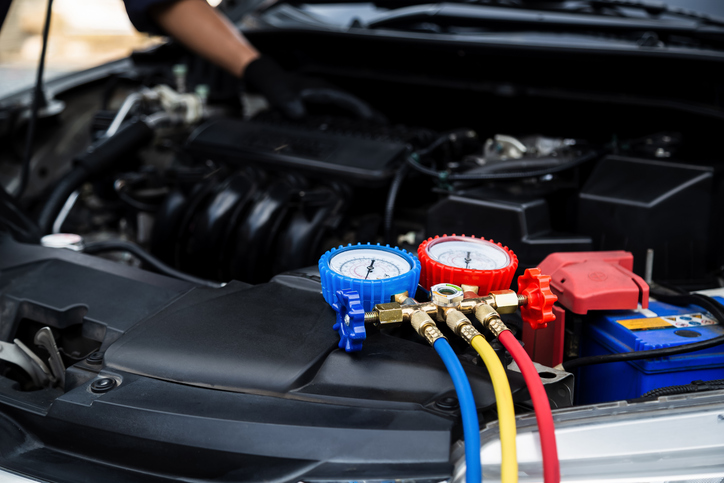
A/C Re-gas & Recharge
Over time, refrigerant gas naturally escapes from your A/C system, reducing cooling efficiency. We’ll evacuate, vacuum-test, and recharge your system with the correct gas (R134a or R1234yf) to restore peak performance.
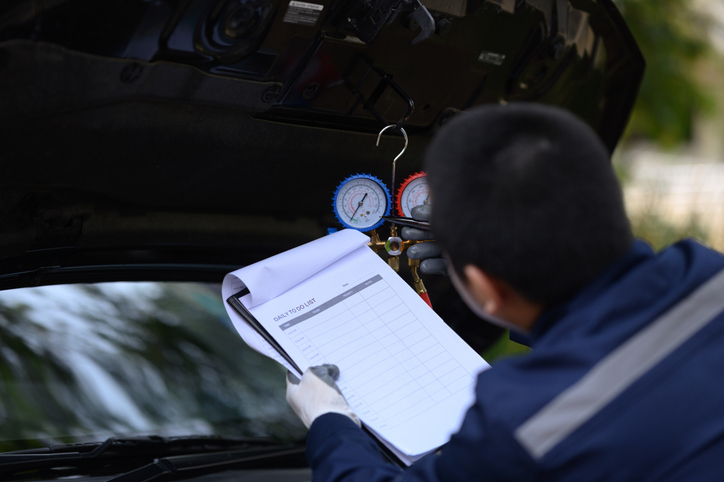
A/C Leak Testing & Diagnosis
If your system loses refrigerant too quickly, our experts use UV dye and electronic leak detection tools to find and fix the problem — preventing future gas loss and expensive repairs.
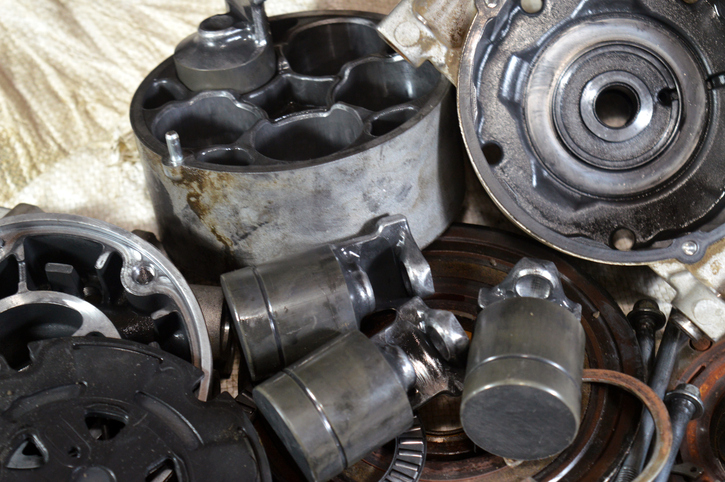
Compressor, Condenser & Evaporator Repairs
We service and replace all key A/C components including compressors, condensers, evaporators, and expansion valves. Only OEM-quality parts are used to ensure long-lasting reliability.
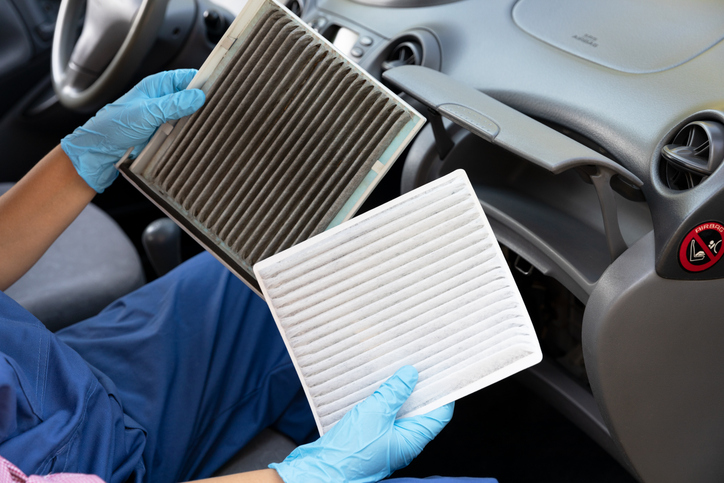
Cabin Filter & Odor Treatment
A clogged cabin filter or bacterial growth can cause unpleasant smells and poor airflow. We offer filter replacement and anti-bacterial A/C cleaning treatments to keep your car’s interior air fresh and healthy.
What Does Galeeco’s AC Service Cover?
AC Regas and Recharge (R134a and R1234yf)
A full vacuum evacuation to remove air and moisture, followed by a precise refrigerant recharge to manufacturer weight specification. Not a quick top-up — a correct service. Both R134a (older vehicles) and R1234yf (newer vehicles from approximately 2017+) are handled with the correct equipment at both Auckland workshops.
AC Leak Detection and Repair
UV dye and electronic leak testing to identify the precise source of refrigerant loss. Once the leak is located, the repair is targeted: hose repair or replacement, seal replacement, compressor shaft seal, or evaporator repair. Followed by a system flush, new receiver-drier, and full regas.
AC Compressor Replacement
The compressor is the heart of the AC system. When it fails — through clutch failure, internal seizure, or bearing failure — it often circulates metallic contamination through the system. We replace the compressor, flush the system thoroughly, replace the receiver-drier and expansion valve, and regas. Skipping the flush after a compressor failure is a common cause of second compressor failures within months.
Condenser Service and Replacement
The condenser sits in front of the radiator and is vulnerable to stone damage, corrosion, and blocked fins. We inspect, clean, and where necessary replace the condenser — particularly important on vehicles in coastal Auckland suburbs where salt air accelerates aluminium condenser corrosion.
Evaporator Service
The evaporator sits inside the dashboard and can develop leaks or become contaminated with mould and bacteria — causing musty, unpleasant cabin air even when the AC is cold. We service evaporators and assess them for leaks, recommending cabin decontamination where mould growth is present.
Cabin Air Filter Replacement
A simple but often neglected item. A blocked cabin filter restricts airflow through the evaporator and makes the AC feel weak regardless of refrigerant level. We check and replace cabin filters across all vehicle types at both workshops.
AC System Flush
Required whenever a major component (compressor, condenser) has failed and potentially circulated contamination through the system. Ensures the new components start with a clean system.
Heating System Diagnosis and Repair
If your car’s heater is underperforming — weak heat, coolant smells in the cabin, or a steaming windscreen — we assess the heater core, coolant circuit, blend doors, and blower system as part of a heating system diagnostic.
All Makes, Models, and Refrigerant Systems
R134a Systems (Pre-2017 vehicles, most of the Auckland fleet)
The majority of vehicles on Auckland roads still use R134a refrigerant. This includes most Toyota, Honda, Mazda, Subaru, Mitsubishi, Hyundai, Kia, Ford, VW, Audi, BMW, Mercedes-Benz, and Holden models manufactured before 2017. Standard AC regas for R134a starts from $180–$250 at Galeeco, depending on vehicle type and refrigerant quantity required.
R1234yf Systems (Newer vehicles, 2017 onwards)
R1234yf is the refrigerant now used in newer vehicles from European manufacturers (VW, Audi, BMW, Mercedes) and increasingly in Japanese and Korean brands. It has a much lower global warming potential than R134a but is significantly more expensive per kilogram and requires specialised recovery equipment. Many Auckland workshops cannot handle R1234yf correctly. Galeeco is equipped for both systems.
European Vehicles (VW, Audi, BMW, Mercedes-Benz, Skoda, Volvo)
European AC systems often have more complex layouts — particularly for rear-seat climate control, multi-zone systems, and dual-evaporator setups in SUVs. We carry the diagnostic tooling (VCDS for VW Group, iDrive and OBD2 for BMW) to read AC-related fault codes and diagnose electronically controlled blend doors, climate control modules, and compressor management systems.
Japanese Vehicles (Toyota, Honda, Mazda, Subaru, Mitsubishi, Nissan)
The majority of our daily AC service work covers Japanese vehicles — the dominant fleet type in South and East Auckland. We carry all common refrigerant receiver-drier and expansion valve specifications for Toyota HiLux, Corolla, RAV4, Prius, Honda CR-V, Accord, Mazda CX-5, Subaru Forester, Outback, and more.
Utes and Light Commercial Vehicles
The AC system in a Ford Ranger, Toyota HiLux, Nissan Navara, or Holden Colorado is under greater strain than a passenger car system — higher underbonnet temperatures, more demanding duty cycles, and greater vibration exposure. We service commercial ute AC systems as part of our broader ute service capability at both Auckland locations.
TWO WORKSHOPS. BOTH EQUIPPED FOR AC WORK.
Mt Wellington Workshop — East and South Auckland
Galeeco’s Mt Wellington workshop is at 65 Leonard Road, Mount Wellington, Auckland 1060, accessible from the Southern Motorway (SH1) via the Mt Wellington Highway interchange. This branch handles AC service and repair for customers from Mt Wellington, Penrose, Onehunga, Otahuhu, Pakuranga, Panmure, and Avondale. We carry both R134a and R1234yf service equipment and stock a range of common compressors, receiver-driers, and expansion valves for fast turnaround on the most common Auckland vehicle types. Phone: 022 472 4444.
Mt Roskill Workshop — West and South-West Auckland
Our Mt Roskill workshop is at 87 Carr Road, Mount Roskill, Auckland 1041, accessible from the Southwestern Motorway (SH20) via the Hillsborough Road interchange. This branch serves AC repair customers from Mt Roskill, Three Kings, Royal Oak, Hillsborough, Lynfield, New Windsor, Avondale, and Māngere Bridge. Same-day AC assessments are available at both branches for most standard regas and leak check jobs — call ahead to confirm availability. Phone: 022 567 2249.
Both workshops are open Monday–Friday 8am–5:30pm and Saturday 9am–5pm. For same-day bookings or urgent enquiries, call the Galeeco hotline: 027 734 4445.
Why Choose Galeeco?
- Certified A/C Technicians
- Advanced Diagnostic Equipment
- Fast, Same-Day Service
- Affordable Pricing with No Hidden Fees
- R134a & R1234yf Compatible Equipment
We Service All Vehicle Types
- Passenger Cars
- SUVs & 4x4s
- Light Commercial Vehicles
- Trucks & Vans
Frequently Asked Questions —Car Air Conditioning Service Auckland
How much does a car AC service cost in Auckland?
A standard car AC service in Auckland typically costs between $180 and $280 NZD for R134a refrigerant systems, and $280–$420 for newer R1234yf systems. These prices include a full system evacuation, refrigerant recharge to manufacturer specification, pressure testing, and a leak check. If a component repair is needed — such as a hose repair, condenser replacement, or compressor replacement — costs range from $450 for a condenser service up to $1,800 for a full compressor replacement. At Galeeco Automotive in Auckland, every AC job starts with a diagnostic assessment and a fixed written quote before any work proceeds.
Why is my car AC blowing warm air?
The most common reasons a car AC blows warm air in Auckland are: low refrigerant level due to a slow leak, a failed compressor or compressor clutch, a blocked or damaged condenser restricting heat exchange, a faulty expansion valve disrupting refrigerant flow, or a failed blend door actuator allowing warm air to mix with cooled air. Low refrigerant is the most frequent cause and the first thing Galeeco checks. However, adding refrigerant to a system with an unresolved leak only provides a temporary fix — the refrigerant will be gone again within weeks or months. Galeeco always investigates the cause of the low refrigerant level before recharging.
What is the difference between R134a and R1234yf refrigerant?
R134a is the refrigerant used in most cars manufactured before 2017. R1234yf is a newer refrigerant now required in vehicles from European manufacturers and increasingly in Japanese and Korean brands from approximately 2017 onwards. R1234yf has a significantly lower global warming potential than R134a but is considerably more expensive per kilogram, which is why R1234yf AC services cost more. The two refrigerants cannot be mixed and require completely different recovery, handling, and recharge equipment. Galeeco Automotive in Auckland is equipped to service both R134a and R1234yf systems correctly at both the Mt Wellington and Mt Roskill workshops.
How often should I service my car's air conditioning in Auckland?
As a general guide, car air conditioning should be serviced — including a full refrigerant check, pressure test, and leak inspection — every 2 years or every 40,000km, whichever comes first. Auckland’s humidity, summer heat, and coastal salt air create conditions that are harder on AC components than many other parts of New Zealand. In practice, most Auckland drivers notice AC performance degradation before the service interval and bring the car in when symptoms appear. Proactive servicing — before the system is noticeably underperforming — typically costs less than reactive repairs, because minor leaks and component wear are caught before they cause secondary damage.
Can I just top up my car's AC gas myself?
DIY AC top-up cans are available from automotive stores in Auckland and are technically usable on R134a systems. However, they have significant limitations: they cannot evacuate the system to remove moisture and air contamination before adding refrigerant, they don’t include a leak check, and they can cause refrigerant overcharge if the system is not actually low. An overcharged AC system can damage the compressor. At Galeeco, a professional regas includes a full vacuum evacuation — which removes moisture that would otherwise cause internal corrosion and ice blockages — followed by a precisely measured recharge to manufacturer specification. The outcome is reliably better and lasts longer than a DIY top-up.
How do I know if my car's AC compressor needs replacing?
Signs that an AC compressor may need replacement include: a grinding, rattling, or squealing noise from the engine bay that gets louder when the AC is switched on, the AC clutch engaging and immediately disengaging repeatedly, no cooling at all even with correct refrigerant level, compressor clutch burning smell, or oil staining visible around the compressor body indicating a shaft seal failure. It’s important to have the compressor properly assessed before replacement — many symptoms attributed to a failing compressor are actually caused by a failing compressor clutch, which is a much less expensive repair. At Galeeco, we assess compressor function specifically before recommending replacement.
Where is the Galeeco Mt Wellington workshop for AC service?
The Galeeco Mt Wellington workshop for car air conditioning service is at 65 Leonard Road, Mount Wellington, Auckland 1060. It is accessible from the Southern Motorway (SH1) via the Mt Wellington Highway interchange, serving AC repair customers from Mt Wellington, Penrose, Onehunga, Pakuranga, Otahuhu, and Panmure. Same-day AC assessments are available at this branch — call ahead on 022 472 4444 to confirm availability, or use the Galeeco hotline on 027 734 4445.
Where is the Galeeco Mt Roskill workshop for car AC repairs?
The Galeeco Mt Roskill workshop for car air conditioning repairs is at 87 Carr Road, Mount Roskill, Auckland 1041, accessible from the Southwestern Motorway (SH20) via the Hillsborough Road interchange. This branch serves AC service customers from Mt Roskill, Three Kings, Royal Oak, Hillsborough, Lynfield, New Windsor, Avondale, and Māngere Bridge. Phone: 022 567 2249.
Does Galeeco service AC on European cars like VW, Audi, and BMW?
Yes. Galeeco Automotive specialises in European vehicle AC service including VW, Audi, Skoda, SEAT, BMW, Mercedes-Benz, and Volvo. European AC systems often involve electronically controlled dual-zone or multi-zone climate control, R1234yf refrigerant, and VCDS or OBD2 diagnostic integration for fault code reading. We carry the specialist tooling and diagnostic equipment for VW Group vehicles in particular, and our team’s experience with European platforms means AC work on these cars is handled with the same confidence as AC work on Japanese vehicles.
What causes a musty smell from the car AC in Auckland?
A musty or mouldy smell from the car AC is caused by bacteria and mould growth on the evaporator core — the component inside the dashboard that chills the air. The evaporator stays damp after the AC shuts off, and in Auckland’s humid conditions, mould and bacteria establish quickly on its surface. The smell is typically worst when the AC is first switched on in the morning. The solution is an evaporator sanitisation treatment — a disinfecting agent applied directly to the evaporator — and in severe cases, evaporator cleaning or replacement. A blocked or overdue cabin air filter also contributes by reducing airflow and creating stagnant conditions inside the evaporator housing. Galeeco checks both the evaporator condition and cabin filter as part of every AC service.
Hot Car? Book an AC Service This Week.
You don’t need to wait until summer has peaked and the workshop is fully booked. A 30-minute AC assessment at Galeeco will tell you exactly what’s going on — and if it’s a standard regas, many jobs can be completed the same day.
If the AC is blowing warm, smelling musty, or you haven’t had it looked at in a couple of years — now’s the right time. A proactive service before the problem worsens is almost always less expensive than an emergency repair in February.
Three ways to get started:
Call us now — describe what your AC is doing and we’ll tell you whether it sounds like a simple regas, a potential leak, or something else. Same-day bookings available most days.
Drive in — both workshops welcome walk-ins for AC assessments. Most standard services take 1–3 hours depending on what’s found.
Book online at galeeco.co.nz — pick a time that works around your schedule.
great team
Our team of great mechanics and tow truck operators have a combined 20+ years of hands on experience.
amazing results
Every time you put your car in our hands you know you’ll get nothing short of amazing results back.
Competative Pricing
We won’t charge you an arm and a leg to get you back up and running – our rates are very reasonable,
Our
Services
Oil changes are one of the most important services to keep your vehicle on the road. One of the quickest and easiest services you can do to care for your vehicle is an oil change.
At our local auto repair shop, we have performed countless oil changes for our valued customers. Regularly performed oil changes ensure that your engine is not being forced to work overtime through dirty oil in order to run.
Diagnosing the Issue
Every manufacturer has different recommendations as to how often and at what mileage you should have your oil change done. Check your owner’s manual for the exact mileage your car’s maker recommends and don’t allow that mileage to pass without getting it done.
Neglecting an oil change will result in causing stress and unnecessary wear on your engine, which could cause it to stop running well before its time. Replacing an entire engine is a very costly repair to make as a result of failing to regularly change the oil.
best auto service
RATED ONE OF THE THE BEST AUTO service IN AUCKLAND
Based on customer reviews – 80+ reviews and counting.